-
ChatGPT: Your Personal News Briefing Assistant

In today’s fast-paced world, staying informed about current events can be challenging. With the abundance of information available online, it can be difficult to find the time to read through all the news articles and still maintain a busy schedule. This is where ChatGPT comes in as a valuable tool for news briefing. ChatGPT is an AI-powered virtual assistant that provides quick and concise summaries of articles, making it an efficient and time-saving solution for staying up-to-date on current events.
ChatGPT provides quick and concise summaries of articles, allowing you to stay informed without having to spend hours reading through multiple sources. With ChatGPT, you can receive a personalized news briefing in just a matter of minutes. See it in action below:
-
Translate English Text to Spanish Effortlessly with ChatGPT
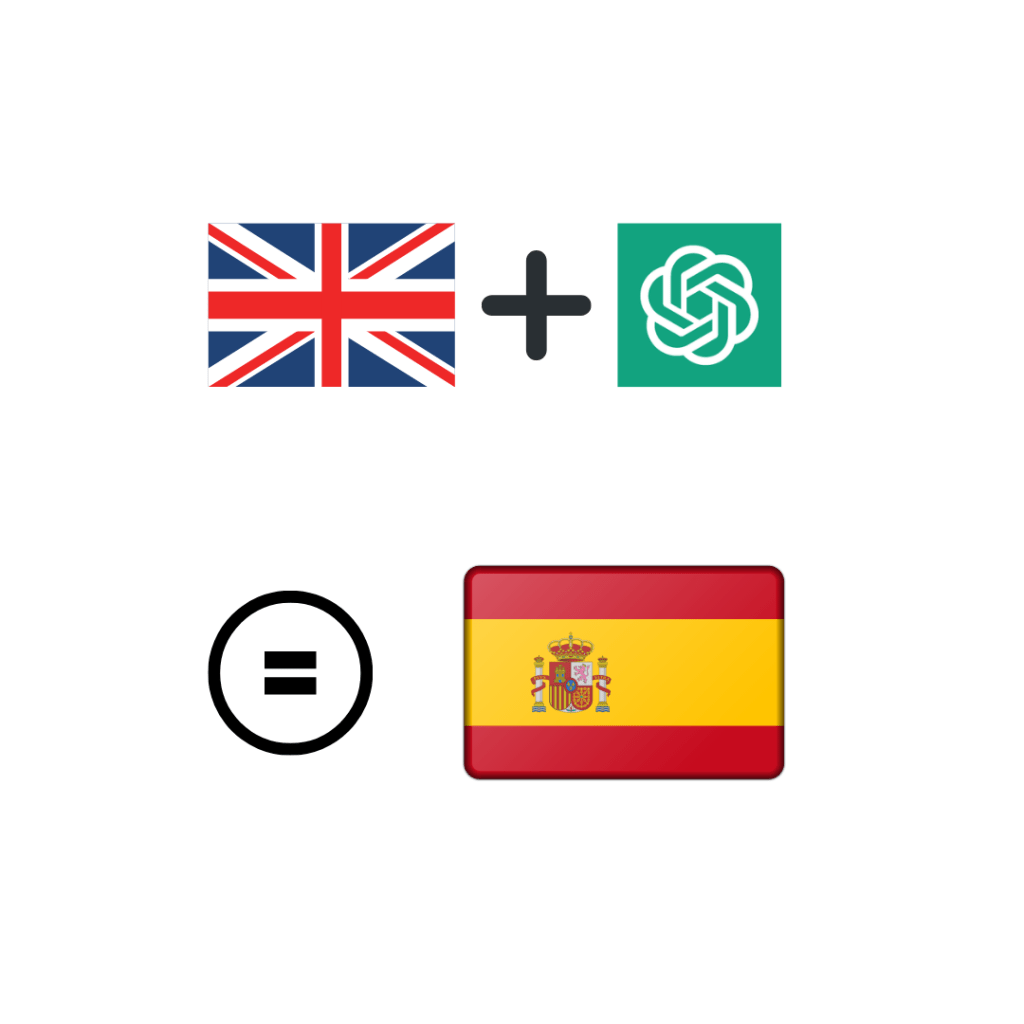
English to Spanish translation is an important task that helps to bridge the communication gap between people who speak different languages. As the world becomes increasingly connected, the need for accurate and efficient translation has never been greater. ChatGPT is a powerful tool that can help you translate English text to Spanish quickly and accurately.
What is ChatGPT?
ChatGPT is a language model developed by OpenAI. It is trained on a massive amount of data and uses deep learning algorithms to generate human-like text. The name “ChatGPT” stands for “Chat Generative Pre-trained Transformer,” which refers to the AI technology that it uses.
How ChatGPT Works
ChatGPT uses a deep learning technique called transformer architecture. This allows it to understand the context and meaning of the text it is translating, which helps to produce more accurate translations. ChatGPT is also pre-trained on a massive amount of data, which means that it has already learned many common words, phrases, and sentence structures. This helps to make the translation process faster and more efficient.
Advantages of Using ChatGPT for English to Spanish Translation
There are several advantages to using ChatGPT for English to Spanish translation. Firstly, ChatGPT is very fast and efficient. You can translate long paragraphs of text in just a few seconds. Secondly, ChatGPT is highly accurate. It uses deep learning algorithms to understand the context of the text, which helps it to produce translations that are close to human-level accuracy. Thirdly, ChatGPT can handle complex sentences and technical terms with ease. Finally, ChatGPT is very accessible and convenient. You can use it from anywhere with an internet connection, making it ideal for people who need to translate text on the go.
Using ChatGPT for English to Spanish Translation
Using ChatGPT for English to Spanish translation is very simple. All you need to do is type or paste the text you want to translate into the ChatGPT interface, and the tool will generate a Spanish translation for you. To get the best results, it is important to use clear and concise language in your English text. You should also try to use common words and phrases where possible, as ChatGPT is more likely to produce accurate translations for these.
Limitations of ChatGPT for English to Spanish Translation
Despite its many advantages, ChatGPT is not perfect. Like all AI-based translation tools, it can sometimes produce translations that are not completely accurate. For example, it may struggle with idioms and cultural references that are specific to one language. In these cases, it is still necessary to use human translators to ensure that the translations are accurate.
Conclusion
ChatGPT is a powerful tool that can help you translate English text to Spanish quickly and accurately. Its speed, accuracy, and convenience make it an ideal choice for people who need to translate text regularly. However, it is important to remember that AI-based translation tools like ChatGPT have their limitations, and human translators are still necessary in some cases. Overall, ChatGPT is a valuable tool that is worth trying for your English to Spanish translation needs.
-
ChatGPT’s Capability to Transform Lowercase to Uppercase and Vice Versa
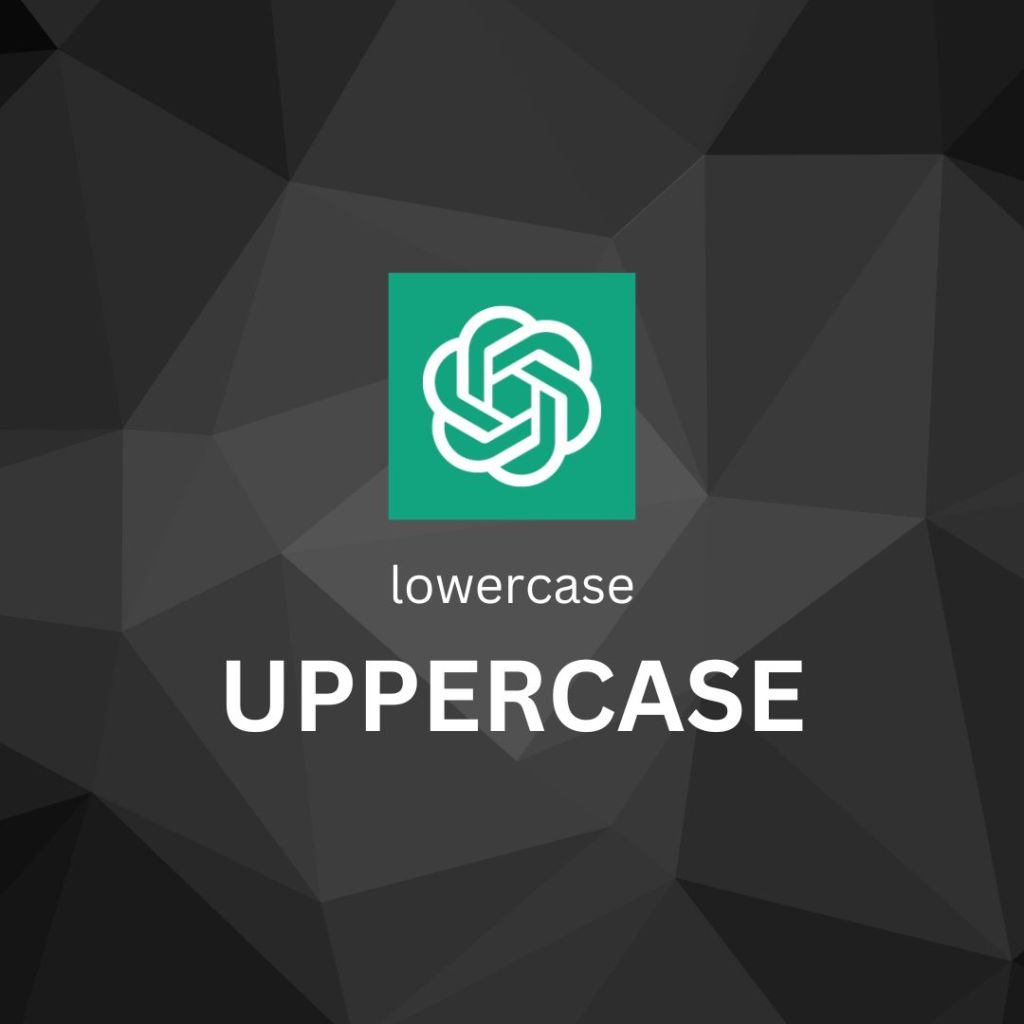
ChatGPT is a state-of-the-art language model developed by OpenAI that can perform various natural language processing tasks, including text conversion. One of the simplest and most common tasks that ChatGPT can perform is converting text from lowercase to uppercase, and vice versa.
See it in action
Try it yourself:
AI: ChatGPT
Random text used: Lipsum.com
-
Interesting Questions You Can Ask ChatGPT
ChatGPT is a cutting-edge artificial intelligence language model developed by OpenAI. This advanced technology allows ChatGPT to generate human-like responses to a wide range of questions, making it an interesting and engaging tool for conversation. Whether you’re looking to spark a thought-provoking discussion or just have a fun conversation, ChatGPT is the perfect companion. In this article, we will explore some of the most interesting questions you can ask ChatGPT, from thought-provoking queries to lighthearted topics. Get ready to be amazed at the depth and diversity of ChatGPT’s responses!
Can you generate a haiku poem for me?
Answer:
Of course! Here is a haiku poem for you:
The sun sets slowly
Colors of the sky ignite
Peaceful and serene.
What’s the meaning of life?
Answer:
The meaning of life is a philosophical question that has been debated for centuries and there is no single, universally accepted answer. The meaning of life can vary for different people, cultures, and beliefs. Some religious or spiritual beliefs hold that life has a divine purpose, while others believe that the meaning of life is subjective and determined by each individual. Some people find meaning in relationships, others in their work or passions, and others in personal growth and self-discovery. Ultimately, the meaning of life is a personal question that each individual must answer for themselves based on their own experiences, beliefs, and values.
Who was the most influential person in history?
Answer:
- Jesus Christ – considered the central figure of Christianity
- Buddha – founder of Buddhism
- Julius Caesar – Roman emperor and military leader
- Napoleon Bonaparte – military leader and emperor of France
- Isaac Newton – scientist who developed laws of motion and universal gravitation
- Mahatma Gandhi – political and spiritual leader in India’s independence movement
- Albert Einstein – theoretical physicist who developed the theory of general relativity
- William Shakespeare – English playwright and poet
- Abraham Lincoln – 16th President of the United States and leader during the American Civil War
- Alexander the Great – King of Macedonia and conqueror of the Persian Empire
Can you summarize the current state of AI research?
Answer:
The current state of AI research is rapidly evolving and advancing. There are a number of different areas of AI research, including:
- Machine Learning: This area focuses on developing algorithms that allow computers to learn from data and improve their performance over time. Machine learning is a key component of many AI applications, including speech recognition, image classification, and natural language processing.
- Deep Learning: A subfield of machine learning, deep learning uses artificial neural networks to model complex relationships in data. This area of AI research has been responsible for many recent breakthroughs, including significant improvements in image and speech recognition.
- Robotics: This area of AI research focuses on the development of robots that can perform tasks autonomously and interact with their environment. Robotic systems often incorporate machine learning and deep learning algorithms to improve their performance and ability to make decisions.
- Natural Language Processing (NLP): This area of AI research focuses on enabling computers to understand and generate human language. NLP has a number of applications, including text classification, sentiment analysis, and language translation.
- Computer Vision: This area of AI research focuses on enabling computers to interpret and understand visual information from the world, such as images and videos. This technology has a number of applications, including image classification, object detection, and image segmentation.
Overall, AI research is making great progress and is being applied in a growing number of fields and industries. However, there are also significant challenges that need to be addressed, such as ensuring that AI systems are transparent, accountable, and trustworthy.
What are some ethical concerns with AI?
Answer:
There are several ethical concerns associated with the development and use of AI technology, including:
- Bias and Discrimination: AI algorithms can perpetuate and amplify existing biases in the data they are trained on, leading to discriminatory outcomes and unequal treatment of certain groups of people.
- Job Automation: The increasing use of AI in various industries can lead to job displacement and economic inequality.
- Privacy and Security: AI systems often process large amounts of personal data, raising concerns about the privacy and security of this information.
- Responsibility and Liability: It can be difficult to determine who is responsible when an AI system causes harm or makes a mistake. This raises questions about accountability and liability.
- Lack of Explainability: Some advanced AI systems, such as deep learning algorithms, can be difficult to understand and interpret, making it challenging to ensure that their decisions are fair and ethical.
- Human Control: As AI systems become more advanced, there are concerns about the potential for them to make decisions or take actions that are harmful to humans, raising questions about the need for human control and oversight.
These ethical concerns highlight the need for responsible and ethical AI development and use, as well as the importance of ongoing research and discussion about the implications of this technology.
Can you explain how GPT-3 works?
Answer:
GPT-3 (Generative Pretrained Transformer-3) is a language generation model developed by OpenAI. It is one of the largest language models to date, with over 175 billion parameters.
GPT-3 works by using a deep learning technique called “transformer architecture”. The model is trained on a massive corpus of text data from the internet, and uses this training data to develop a representation of the patterns and relationships in human language.
During the training process, the model is exposed to a large amount of text and learns to predict the next word in a sequence based on the context provided by the preceding words. Once trained, the model can then generate new text that is coherent and resembles human writing.
GPT-3 can be used for a variety of language tasks, including text completion, question answering, machine translation, and more. It can also be fine-tuned for specific tasks and domains, allowing it to generate more targeted and accurate responses.
Overall, GPT-3 represents a major advance in the field of AI and natural language processing, and has the potential to impact a wide range of industries and applications.
What do you think the future of work will look like with AI?
Answer:
The future of work with AI is a subject of much discussion and speculation, but it is widely believed that AI will have a significant impact on the job market and the nature of work in the coming years. Here are a few possible ways in which AI could shape the future of work:
- Automation of manual and repetitive tasks: AI systems are capable of automating many manual and repetitive tasks, freeing up humans to focus on more complex and creative tasks.
- Job Displacement: While AI has the potential to create new jobs, it is also likely to displace many existing jobs, particularly in industries such as manufacturing and administrative support.
- Augmentation of human skills: AI can also be used to augment human skills, making humans more productive and efficient in their jobs. For example, AI can assist in decision-making and improve the accuracy of predictions and forecasts.
- New job creation: AI has the potential to create new job opportunities in areas such as AI development and maintenance, data analysis, and cybersecurity.
- Changes in the nature of work: AI may also change the nature of work by enabling remote work and increasing the demand for flexible working arrangements.
Overall, the future of work with AI is likely to be complex and multifaceted, with both challenges and opportunities. It is important for individuals and organizations to prepare for the impact of AI and develop strategies to adapt and thrive in this changing landscape.
Can you generate a story based on a given prompt?
In this example we used Frankenstein.
Answer:
Once upon a time, there was a brilliant scientist named Victor Frankenstein who was obsessed with the idea of bringing the dead back to life. Despite the warnings of his friends and family, he devoted himself to his work and finally succeeded in creating a monster from dead tissue.
Initially, Frankenstein was filled with pride and joy at his accomplishment. However, as soon as he saw the monster, he was overcome with horror and disgust at what he had created. The monster, abandoned and alone, roamed the countryside causing terror and destruction wherever it went.
Frankenstein eventually realized that he was responsible for the monster’s actions and set out to find it, determined to destroy the creature he had brought to life. The monster, meanwhile, was searching for Frankenstein, seeking revenge for being cast aside and hated.
The two met in the Arctic, where Frankenstein was on the brink of death. The monster approached him, ready to end his life, but upon seeing the scientist’s condition, it realized the toll its actions had taken on Frankenstein. In that moment, the monster felt a deep sense of remorse for its deeds and chose to end its own life, unable to live with the guilt and sorrow.
Frankenstein died soon after, exhausted and haunted by the memory of the monster he had created. The story of the monster and its maker serves as a cautionary tale about the dangers of unchecked ambition and the consequences of playing God.
Can you translate text into another language?
Answer:
Yes, I can translate text into another language. We cover this more here.
Can you provide a summary of the current global political situation?
Answer:
As of my knowledge cutoff of 2021, the current global political situation is complex and dynamic, shaped by a range of factors such as the COVID-19 pandemic, economic challenges, geopolitical tensions, and social and political movements. Here are a few key developments:
- COVID-19 Pandemic: The COVID-19 pandemic continues to impact the world, leading to widespread illness, death, and economic hardship, as well as affecting the political landscape. Governments around the world are grappling with how to respond to the crisis and balance public health concerns with economic and political considerations.
- US-China Relations: Tensions between the US and China remain high, with both countries engaging in economic, technological, and military competition. This has led to increased tensions in the Indo-Pacific region and has far-reaching implications for the global political and economic order.
- Rise of Populism: Populist movements and political leaders continue to gain support in many countries, challenging established political systems and posing challenges to the traditional political establishment.
- Global Economic Challenges: The global economy is facing numerous challenges, including slow growth, rising inequality, and persistent poverty, among others. Many countries are grappling with how to promote economic growth and reduce inequality, and this is shaping the political landscape in significant ways.
- Climate Change: Climate change is increasingly becoming a major political issue, with countries around the world taking steps to reduce greenhouse gas emissions and transition to a more sustainable future.
These are just a few examples of the complex global political situation. The situation is continually evolving and there are many other factors at play that are shaping the current political landscape.
-
ChatGPT Can Format Text Data Into a Table
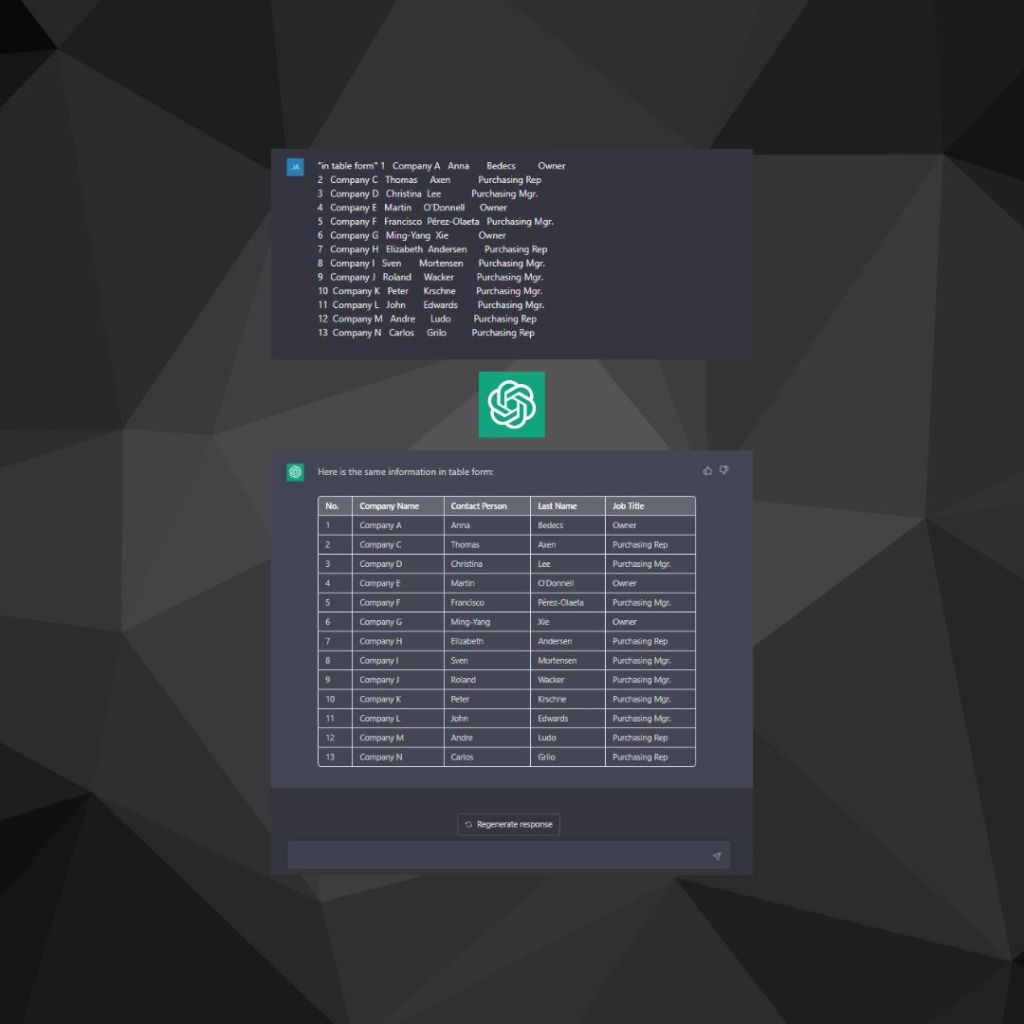
ChatGPT, developed by OpenAI, is a cutting-edge language model that has the ability to convert text to table form. This functionality can be useful for those who need to present data in an organized manner, for example, for data analysis or presentation purposes. In this article, we’ll discuss how ChatGPT can be used to convert text to table form.
- Understanding the Input Data: Before using ChatGPT to convert text to table form, it is important to understand the structure of the input data. The data should be organized in a tabular format with each row of data separated by a line break. Each column should also be separated by a delimiter, such as a comma or tab.
- Formatting the Input Data: Once the data is organized, it can be passed to ChatGPT as input. To ensure that the output is in the desired format, it is important to specify the delimiter used to separate the columns in the input data.
- Generating the Output Table: ChatGPT can then generate the output table based on the input data and the specified delimiter. The model uses its advanced language processing capabilities to recognize the structure of the data and produce a table with the correct number of rows and columns.
- Customizing the Output Table: ChatGPT also allows users to customize the output table by specifying the desired table format. This can include adding headers, adjusting the column width, or specifying the type of table (e.g. HTML, Markdown, CSV).
Example:
In this example we take some text from the Microsoft website to show how ChatGPT comfortably converts text into table form.
In conclusion, ChatGPT’s ability to convert text to table form is a valuable tool for those who need to present data in an organized manner. With its advanced language processing capabilities and customization options, ChatGPT is an efficient and effective solution for converting text data into table form.
-
How ChatGPT Can Grow Your TikTok Account
ChatGPT can be a valuable tool for growing your TikTok account by assisting in various tasks such as content creation, engagement, and audience analysis.
- Content Creation: ChatGPT can generate captions, hashtags, and even video ideas that align with your TikTok account’s theme and target audience. This can save time and effort in coming up with creative content ideas.
- Engagement: ChatGPT can help you interact with your followers and other TikTok users by generating comments and replies to their posts. This can increase your engagement and help you build a relationship with your followers.
- Audience Analysis: ChatGPT can analyze your TikTok account’s audience and provide insights on their interests, demographics, and behavior. This information can be used to tailor your content and improve your account’s overall performance. Simply paste your profile link into the AI and ask it to analyze your audience.
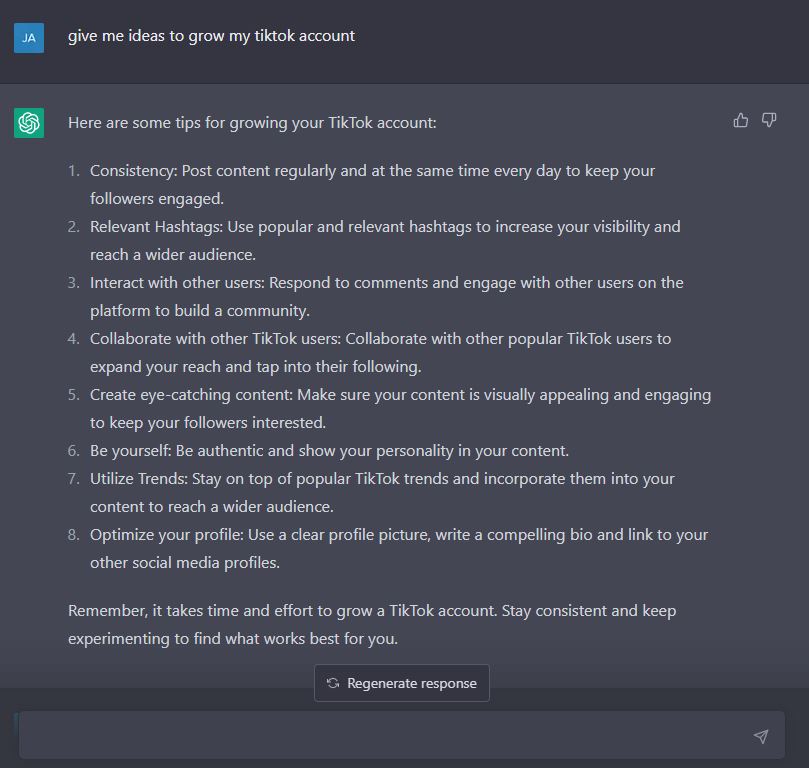
In conclusion, ChatGPT can be a valuable asset for growing your TikTok account by streamlining content creation, increasing engagement, and providing valuable insights into your audience. Utilizing ChatGPT’s capabilities can help you save time and effort while improving your account’s overall performance.
-
Can ChatGPT Translate Between Multiple Languages?
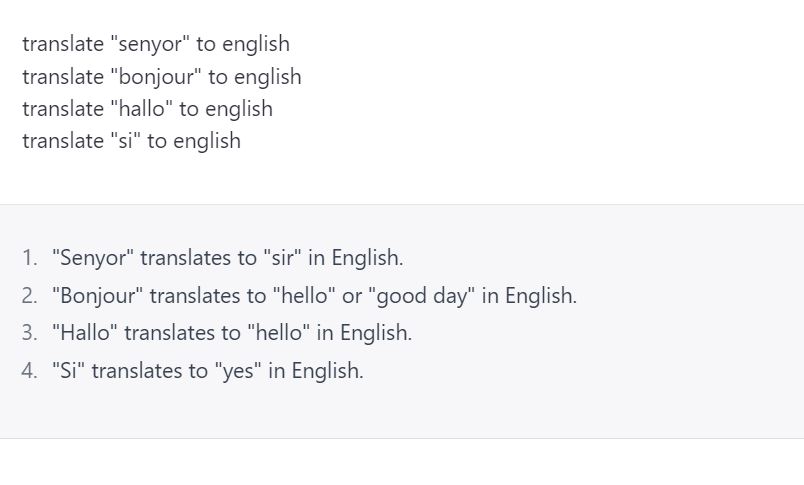
The short answer is yes, but.
ChatGPT can translate between multiple languages to a certain extent, but it might not be as good as dedicated translation tools, yet.
ChatGPT supports multiple languages, including English, Spanish, French, German, Italian, and many others. This makes it a suitable solution for individuals and organizations that require translation in different languages. Furthermore, ChatGPT’s ability to translate text in real-time means that you can use it for live conversations, whether in person or online.
In addition to its speed and versatility, ChatGPT’s language translation is also highly accurate. The model is trained on vast amounts of text data and uses advanced algorithms to produce translations that are both natural-sounding and accurate. This is especially important for businesses and organizations, as incorrect translations can lead to misunderstandings and miscommunication.
Examples of ChatGPT’s Language Translation:
- Real-time translation during a conversation: A person speaking in Spanish can use ChatGPT to translate their words to English in real-time, allowing them to communicate effectively with someone who doesn’t speak Spanish.
- Translation of a written document: A French business person can use ChatGPT to translate a French business proposal into English, making it easier for their English-speaking colleagues to understand.
- Translation of a website: A German company can use ChatGPT to translate their website into English, making it accessible to a wider audience.
- Translation for language learning: An Italian student can use ChatGPT to translate Italian texts into English, helping them to improve their language skills.
- Translation for social media: A Spanish influencer can use ChatGPT to translate their Spanish Instagram captions into English, allowing them to reach a broader audience.
These are just a few examples of the many ways ChatGPT’s language translation capabilities can be used. Whether you need to translate a personal message, a professional document, or anything in between, ChatGPT is a useful tool that can help you overcome language barriers and facilitate effective communication.
Working Examples:
The following translates basic words from Spanish, French, German, and Italian:
In conclusion, ChatGPT’s language translation capabilities are a valuable asset in today’s fast-paced and interconnected world. With its speed, versatility, and accuracy, it is an excellent solution for individuals and organizations in need of reliable translation services. Whether you’re communicating with colleagues, customers, or friends, ChatGPT’s language translation can help you overcome language barriers and facilitate seamless communication.
-
Can ChatGPT Write Poems?
ChatGPT, a large language model developed by OpenAI, has been making waves in the field of natural language processing. One of its most impressive capabilities is its ability to generate text, including poetry. But can ChatGPT truly write poetry?
To answer this question, it’s important to understand how ChatGPT works. ChatGPT is a machine learning model that has been trained on a large dataset of text. It uses this training to understand the patterns and structures of language, allowing it to generate new text that is coherent and makes sense.
One of the ways that ChatGPT can generate text is by completing a prompt, such as a sentence or a phrase. For example, when given the prompt “The sky is a canvas painted,” ChatGPT can generate the following response: “blue with fluffy clouds that glide on through.” This response, although not completely original, shows that ChatGPT has an understanding of the structure and meaning of language.
Poem Generated By ChatGPT
“The sky is a canvas painted blue, With fluffy clouds that glide on through. The sun is a brush that paints the day, And the stars are the paint that light the way.
The trees are the strokes that fill the land, With green and brown, a natural band. The flowers are the colors that brighten the scene, A rainbow of hues, so serene.
The breeze is the artist that shapes the view, With the rustle of leaves and the swaying of the dew. Nature’s artwork is a beauty to behold, A masterpiece that never grows old.
So let us take a moment to appreciate, The artistry that surrounds us and create, A world of wonder and a heart of gratitude, For the beauty that surrounds us, for it’s all good.”When it comes to poetry, ChatGPT’s ability to understand language patterns and structure is particularly useful. It can generate poems that have a clear structure, such as rhyme and meter, and that convey a clear message. In many cases, the poems generated by ChatGPT are coherent and make sense, and they can even be emotionally evocative.
However, it is important to note that ChatGPT is not truly “writing” poetry in the sense that a human would. The poems it generates are based on patterns and structures it has learned from its training data, rather than on its own creativity or personal experience.
In conclusion, ChatGPT is capable of generating poetry that is coherent and makes sense, with a clear structure and message. However, it is not truly writing poetry in the sense that a human would, as it relies on patterns and structures it has learned from its training data. Despite this, ChatGPT’s ability to generate poetry is a testament to the impressive capabilities of natural language processing technology.
-
ChatGPT’s Email Writing Capabilities
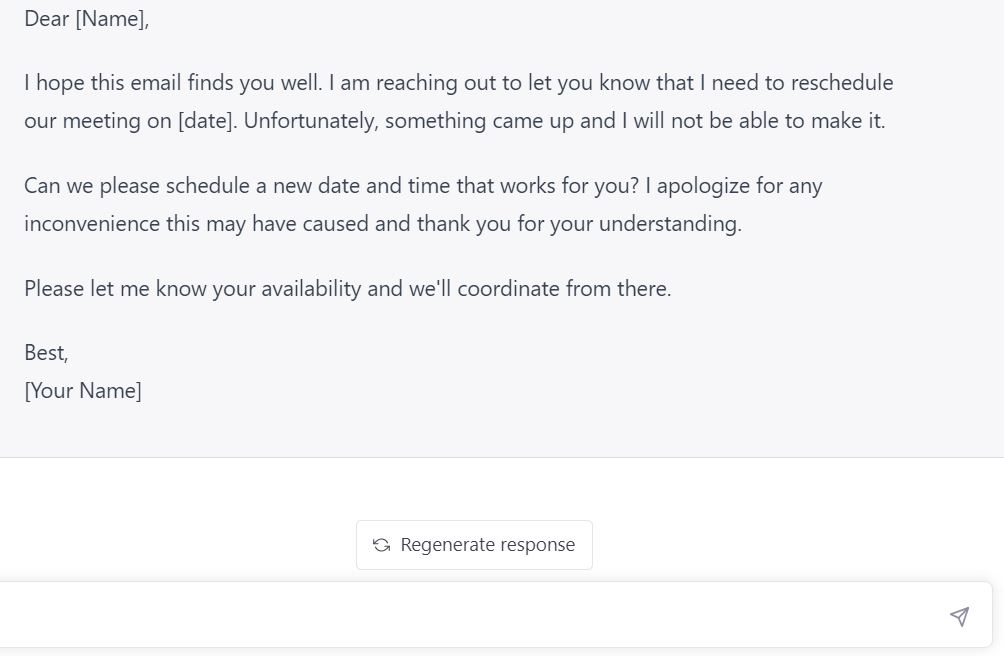
ChatGPT, developed by OpenAI, is a powerful language generation model that can assist users in a variety of tasks, one of which is writing email templates. With its advanced natural language processing capabilities, ChatGPT can generate highly personalized and effective email templates that can be used for a wide range of purposes, from reaching out to potential clients to scheduling meetings and following up on conversations.
One of the key advantages of using ChatGPT for writing email templates is its ability to understand and respond to context. For example, when asked to write a cold email template for reaching out to potential clients, ChatGPT can analyze the information provided by the user, such as the company name and industry, and generate a personalized email that is tailored to the specific needs of that company. This can greatly increase the chances of the email being read and responded to, as it shows that the sender has done their research and is genuinely interested in working with the recipient.

Another advantage of using ChatGPT for writing email templates is its ability to generate highly persuasive and compelling language. ChatGPT has been trained on a vast amount of text data, and as a result, it has a deep understanding of how to craft effective and convincing messages. This can be particularly useful when writing follow-up emails or proposing a business partnership, as ChatGPT can generate language that is designed to persuade the recipient to take action.

In addition to its natural language processing capabilities, ChatGPT also has a user-friendly interface that makes it easy to use. Users can simply input the information they want to include in the email template, and ChatGPT will generate a polished, professional email in a matter of seconds. This can save users a significant amount of time and effort, as they no longer have to spend hours crafting the perfect email.
In conclusion, ChatGPT is a powerful tool that can assist users in writing highly effective and personalized email templates. With its advanced natural language processing capabilities and user-friendly interface, ChatGPT can save users a significant amount of time and effort while also increasing the chances of their emails being read and responded to.
Job Applications
In addition to writing email templates, ChatGPT can also assist users in creating professional and effective resume’s (or CVs) and cover letters. With its advanced natural language processing capabilities, ChatGPT can help users to highlight their skills and experience in a way that is tailored to the specific job they are applying for.
Read more about the AI’s job application capabilities here.
-
ChatGPT’s Script Writing Abilities
Can ChatGPT write/rewrite scripts?
ChatGPT is a powerful language model that has been trained on a vast amount of text data, which makes it well-suited for writing scripts. One of its key strengths is its ability to generate coherent and natural-sounding text that closely mimics human writing.
One way in which ChatGPT can be used to write scripts is by providing it with a prompt or a few examples of script writing and it can generate new script based on the provided input. This makes it easy for writers and script-editors to quickly generate new ideas or complete scenes.
Another advantage of ChatGPT is its ability to understand and respond to context. This allows it to generate scripts that are consistent with the tone, style, and genre of the provided input. This can be very useful when working on a specific project that requires a particular style or tone. This is a huge advantage for YouTubers that rely on a lot a script writing for their videos. ChatGPT can help to ensure that the video stays on topic and flows smoothly from one idea to the next, allowing creators to pay attention to pacing, dialogue, and other elements that can make a video more engaging and entertaining for viewers.
Additionally, ChatGPT can be fine-tuned on specific script writing dataset to improve its performance on that specific task which will help it to generate more accurate and relevant script.
For example, let’s say your writing a script for a new intro to your video and you’ve given the AI a vague command. To enhance the answer you can simply carry on from where you left off, being more specific so the AI can write you a more specific introduction tailored to your channel.
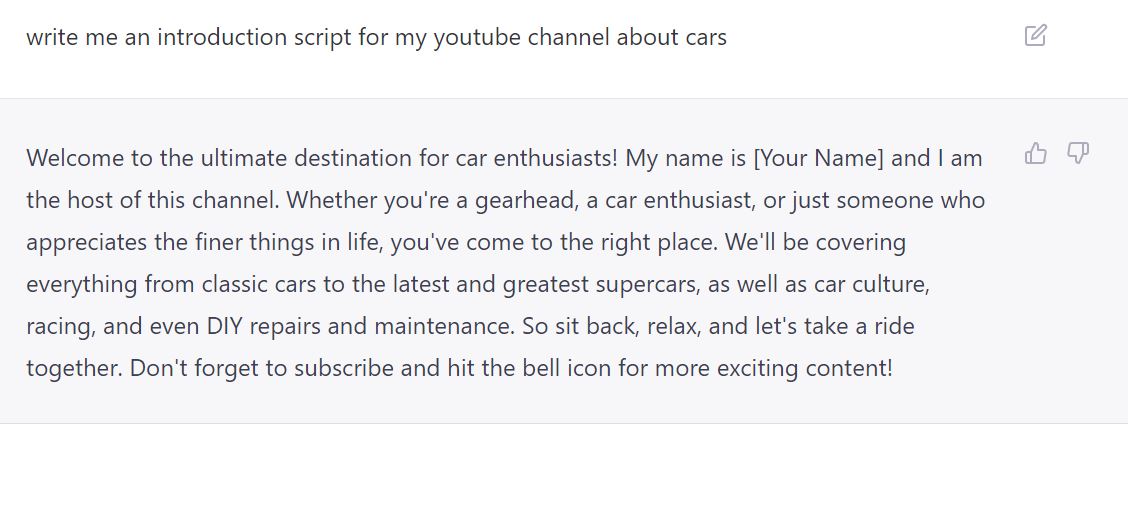
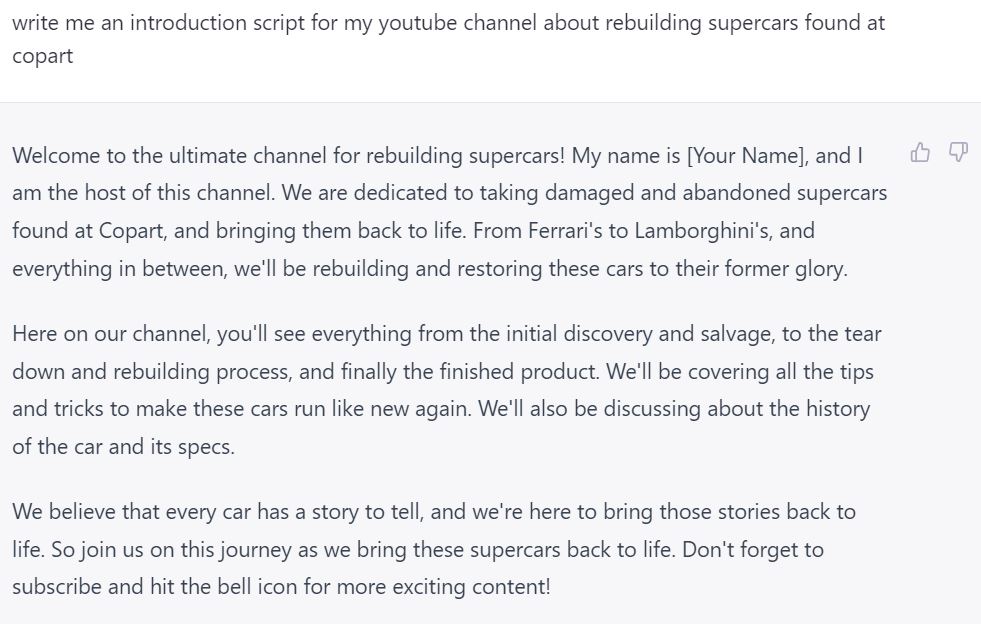
Overall, ChatGPT’s ability to generate high-quality script and its ability to understand and respond to context make it a valuable tool for writers and script-editors.
Coding
ChatGPT is able to understand and respond to a wide range of programming languages, including popular languages such as Python, Java, C++, and JavaScript. It can assist with coding-related tasks such as debugging, troubleshooting, and code generation. It can also provide explanations of code snippets and programming concepts, and help users understand the logic behind a piece of code.
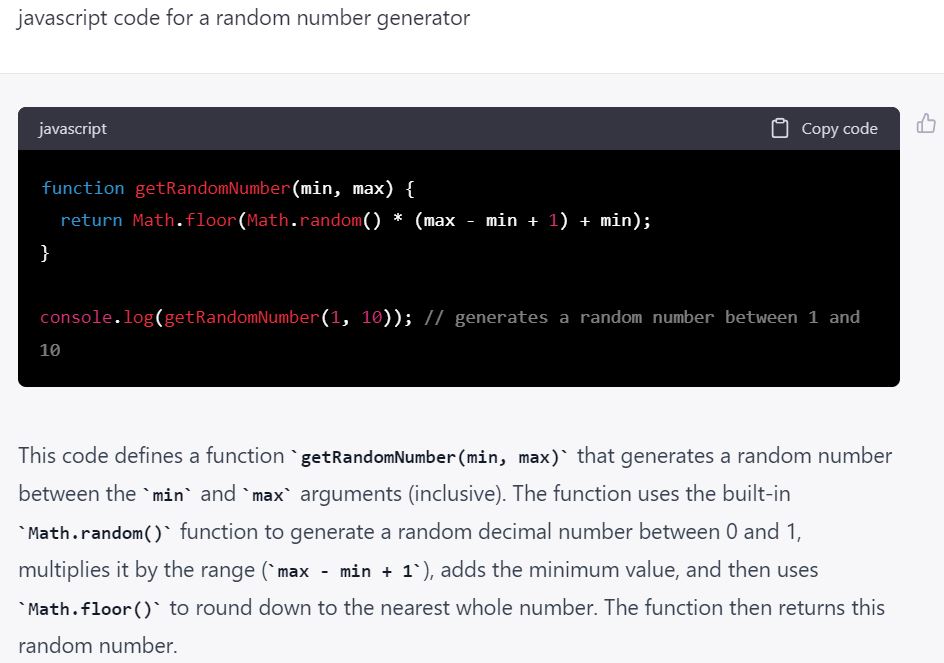
One of ChatGPT’s more powerful features is its ability to generate code. Given a set of inputs such as the programming language and a brief explanation of the desired functionality, ChatGPT can generate a complete code snippet that can be used in a variety of contexts. This can be a great time saver for developers, as it eliminates the need to manually write code from scratch.
An example of ChatGTP’s coding abilities:
Now in a HTML file:
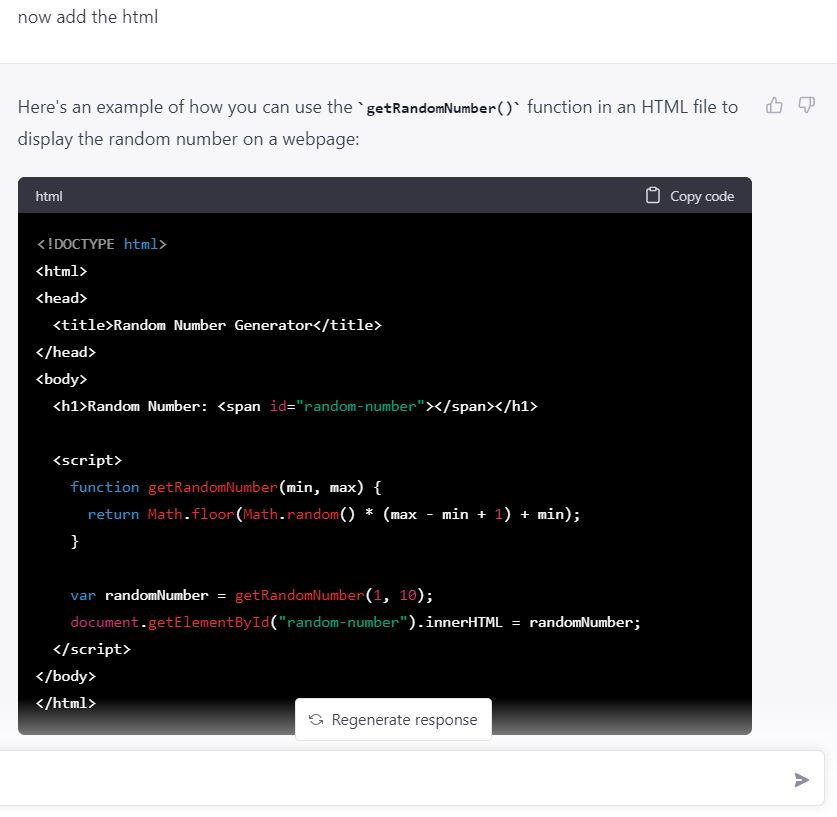
Overall, ChatGPT’s ability to generate high-quality script and its ability to understand and respond to context make it a valuable tool for writers, coders and script-editors.
-
Subscribe
Subscribed
Already have a WordPress.com account? Log in now.
 ChatGPT Novice